
Basics in mechanical surface treatment
How to improve your components
Our free webinar for an excellent surface finish
- Introduction and classification of mechanical surface treatment
- Description of surface and edge zone properties
- Effects of roller burnishing and deep rolling on component properties
Download now!
Surface Engineering through mechanical processing
The properties of a surface can be specifically and reliably imparted using mechanical surface treatment processes. This allows the desired functions of the components to be achieved cost-effetively and reproducibly.
The best-know mechanical surface treatment processes:
Shot blasting
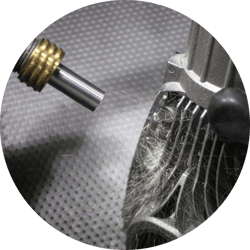
In shot blasting, spherical abrasive particles are blasted onto the surface in a targeted manner. The impacts cause deformation of the surface and harden it.
Roller burnishing
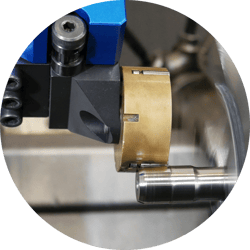
The surface is continuously plastically deformed by pressing in and rolling a ball or roller. This creates a particularly smooth surface without removing any material.
Deep rolling
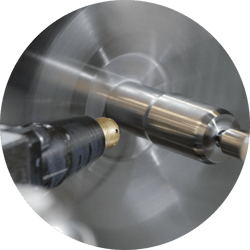
As with roller burnishing, the surface is treated with a roller or ball. However, the process is carried out with the aim of introducing compressive stresses and work hardening and increasing strength.
Diamond smoothing
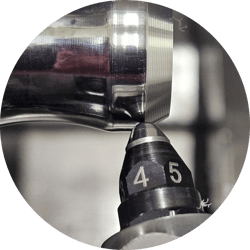
Mechanical pressing of a diamond hemisphere into the surface. The pressing causes the diamond to rub against the surface, thereby smoothing it.
Machine hammer peening
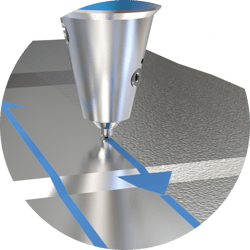
Impulse-like stressing of the surface by a hammer head to significantly strengthen the surface. The impulse generated by the hammering results in a significantly greater penetration depth into the surface.
Skiving/roller burnishing
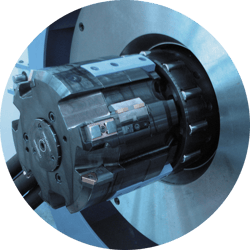
Fast and efficient internal machining of cylinder tubes through a combination of boring, internal round peeling, and roller burnishing.