
Rz<1µm without grinding
How to improve your components
Our free webinar for an excellent surface finish
In just 30 minutes, our Head of Research and Development, Dr. Oliver Maiß, will explain how you can optimize your components through mechanical surface treatment!
- You will learn about the basic process flow of burnishing and roller burnishing
- You will understand the opportunities and limitations of the process
- You will get a feel for the achievable surface characteristics beyond the classic characteristics Ra and Rz
Download now!
Surface Engineering through mechanical processing
The properties of a surface can be specifically and reliably imparted using mechanical surface treatment processes. This allows the desired functions of the components to be achieved cost-effetively and reproducibly.
The best-know mechanical surface treatment processes:
Shot blasting
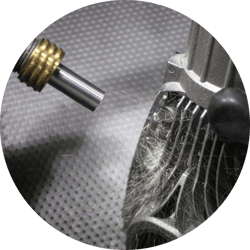
In shot blasting, spherical abrasive particles are blasted onto the surface in a targeted manner. The impacts cause deformation of the surface and harden it.
Roller burnishing
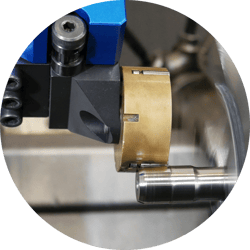
The surface is continuously plastically deformed by pressing in and rolling a ball or roller. This creates a particularly smooth surface without removing any material.
Deep rolling
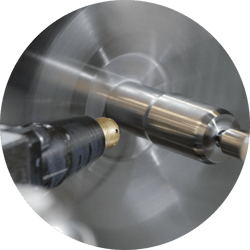
As with roller burnishing, the surface is treated with a roller or ball. However, the process is carried out with the aim of introducing compressive stresses and work hardening and increasing strength.
Diamond smoothing
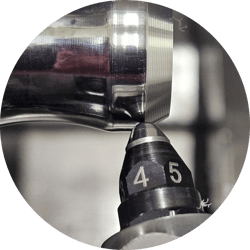
Mechanical pressing of a diamond hemisphere into the surface. The pressing causes the diamond to rub against the surface, thereby smoothing it.
Machine hammer peening
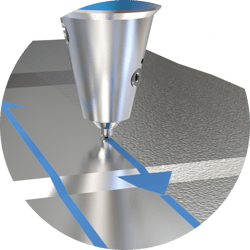
Impulse-like stressing of the surface by a hammer head to significantly strengthen the surface. The impulse generated by the hammering results in a significantly greater penetration depth into the surface.
Skiving/roller burnishing
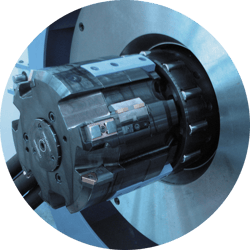
Fast and efficient internal machining of cylinder tubes through a combination of boring, internal round peeling, and roller burnishing.